


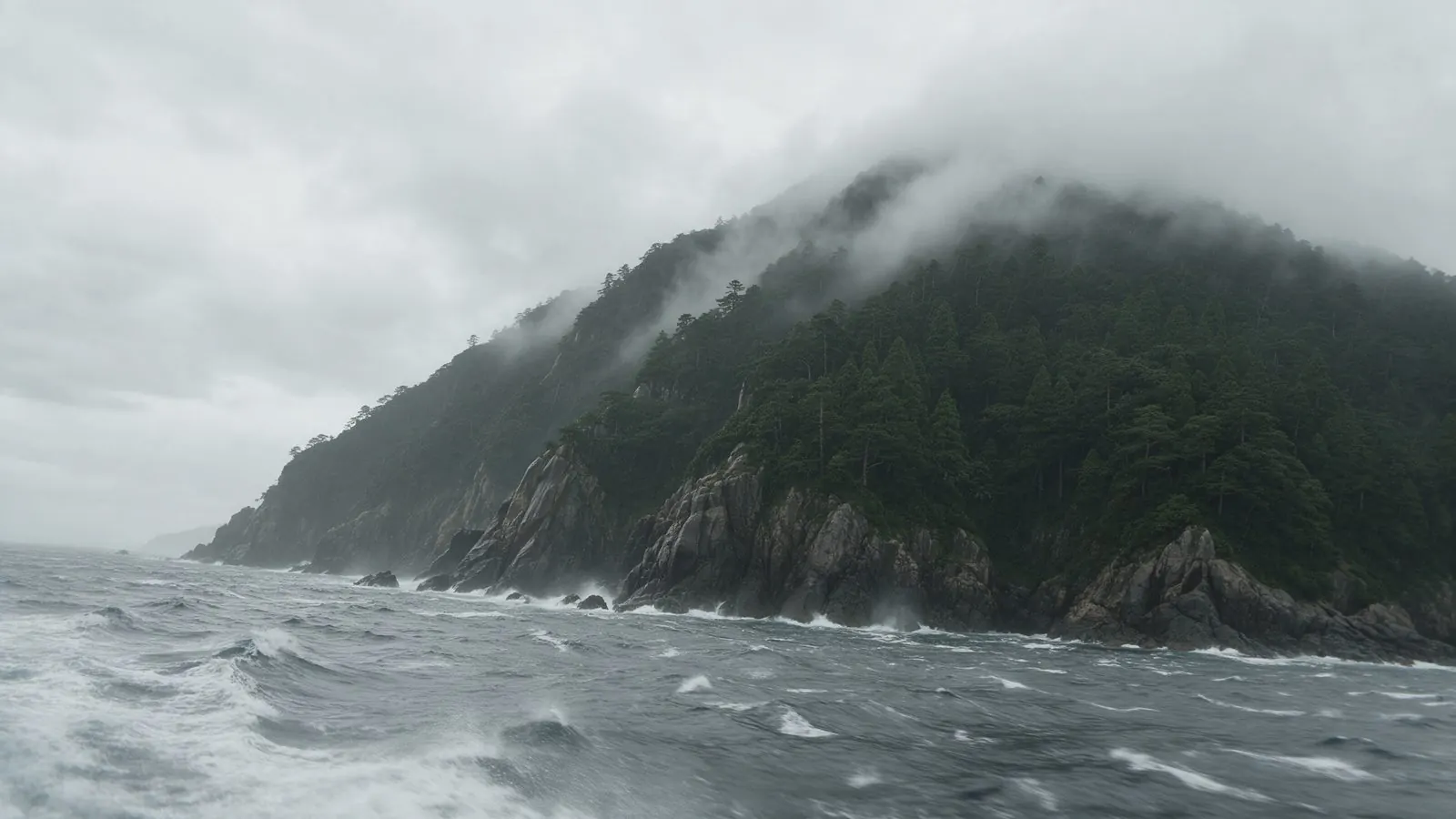
Kagoshima sits at the bottom of Kyushu with an active volcano four kilometres across the water, venting most days and dusting the city with ash often enough that residents keep dedicated bags for sweeping it up. Two hours further south by hydrofoil, Yakushima rises almost two thousand metres straight out of the Pacific and catches so much rain that its interior is a temperate rainforest of cedars a thousand and more years old. Together they are the most distinctive pairing in the Kyushu region, and the least sold.
Kagoshima city and Sakurajima
- The volcano is the view from everywhere — the ferry runs 24 hours and takes fifteen minutes, so Sakurajima is a genuine half-day rather than an expedition. Observation points, lava fields from the 1914 eruption that joined the island to the mainland, and a free foot bath along the shore.
- Eruption levels change the plan. Access to the upper zones closes when activity rises, which happens several times a year. Any Sakurajima itinerary needs a stated alternative, and the group should know that before they arrive.
- Sengan-en, the Shimazu clan's coastal garden, uses Sakurajima as borrowed scenery — the volcano is deliberately framed as part of the garden. It also holds Japan's earliest industrial heritage, a UNESCO-listed reverberatory furnace site from the 1850s.
- The Meiji Restoration story is Kagoshima's story. Saigo Takamori, the Satsuma domain, the students smuggled to London — for files with any historical interest, this is where the modern country was argued into being. Pair it with the history briefing for agents.
- Shochu, not sake. Kagoshima is the sweet-potato shochu capital, and distillery visits here are the equivalent of a sake brewery day further north.
Ibusuki and the southern cape
An hour south of the city, Ibusuki's sand baths bury guests to the neck in naturally steam-heated black sand on the beach. It is genuinely unusual, photographs brilliantly and takes twenty minutes, which makes it excellent itinerary value. Beyond it, Cape Nagasakibana looks toward Kaimondake — a near-perfect volcanic cone the locals call Satsuma-Fuji — and Lake Ikeda fills a caldera behind. The whole southern loop is a comfortable day from Kagoshima by road.

Yakushima: the island that needs planning
Yakushima is UNESCO-listed, rains famously — the local saying is thirty-five days a month — and rewards groups who arrive prepared and punishes those who do not.
- Access is by hydrofoil (about two hours) or a short flight from Kagoshima. Both cancel in rough weather, which is the single biggest operational risk on the island. Never schedule a Yakushima departure on the same day as an international connection.
- Jomon Sugi is a full day — around ten hours return on a former logging railway and mountain trail, with a very early start. It is not a group walk for a mixed-ability party, and it should be sold honestly or not at all.
- Shiratani Unsuikyo is the answer for most groups: mossy ravine forest, well-made trails, sections of two to four hours, and the landscape that inspired the forest scenes in Princess Mononoke.
- Yakusugi Land offers boardwalk loops from thirty minutes upward and works for almost anyone, including older travellers.
- Wildlife is visible and abundant — Yakushima macaques and sika deer along the mountain roads, and loggerhead turtles nesting on the north-west beaches from May to July under a strict permit system.
- Guiding is effectively mandatory on the mountain trails, and the good local guides book out in the green season.
Making it work in an itinerary
Southern Kyushu is a three-to-five-night proposition and it does not combine well with a rushed Golden Route file. The clean builds are: fly into Kagoshima, two nights city and Ibusuki, two nights Yakushima, fly out — or run it as the southern end of a full Kyushu circuit down from Fukuoka through Beppu and Yufuin. The Kyushu Shinkansen puts Kagoshima-Chuo about ninety minutes from Kumamoto and under four hours from Osaka, so an overland arrival is realistic. Add a buffer night before any onward flight if Yakushima is in the file.
How a Japan DMC handles it
We build Yakushima with the weather risk priced in — a buffer night before onward flights, a mainland alternative held, and hydrofoil versus flight chosen on the forecast rather than the brochure. We match the trail to the party honestly, engage the licensed mountain guides who actually know the routes, keep a live Sakurajima alternative in every file, and place the shochu distilleries and Sengan-en where they do real work. Rates run through the standard net rate structure.
FAQ
How do you get to Yakushima from Kagoshima? By hydrofoil in around two hours or a short domestic flight of about forty minutes. Both are weather-dependent and cancel in rough seas or heavy wind, so files should carry a buffer night on the mainland before any onward international connection.
Is the Jomon Sugi hike suitable for a group? Rarely. It is roughly a ten-hour return day with a pre-dawn start on mountain trail and old railway track, and it is not appropriate for a mixed-ability party. Shiratani Unsuikyo and Yakusugi Land deliver the same forest with sections from thirty minutes to four hours.
Can you visit Sakurajima volcano? Yes — a 24-hour ferry crosses from Kagoshima in fifteen minutes and the island has observation points, lava-field walks and a free foot bath. Upper access closes when eruption activity rises, which happens several times a year, so every itinerary needs a stated alternative.
What are Ibusuki's sand baths? Naturally steam-heated black sand on the beach, in which guests are buried to the neck in a yukata for about twenty minutes. It is unique to the area, works for most fitness levels and sits an hour south of Kagoshima on an easy day loop.
Selling Japan's deep south? Write to b2b@explera.jp, message the trade desk on WhatsApp at +66 93 656 8090, or register on the B2B portal. Proposals within 24 hours. IATA 96215733, ASTA member 900408341.


